Brother P-touch labelers simplify organization, offering professional-quality labels for diverse applications.
This guide ensures optimal use, referencing manuals and safety instructions for a seamless experience.
These devices are user-friendly, creating high-quality labels with ease, as detailed in the product manual.
What is a P-Touch Labeler?
A P-touch Labeler is a compact, portable device designed for creating customized labels. These electronic label makers utilize thermal printing technology, eliminating the need for ink.
They accept tape cassettes containing laminated plastic tape, offering durability and resistance to various conditions.
Brother’s P-touch series offers diverse models, from basic to advanced, catering to home, office, and industrial needs.
The manual details features like font styles, sizes, symbols, and barcode printing, enabling professional-looking labels for organization and identification.
Benefits of Using a P-Touch Labeler
P-touch Labelers offer numerous advantages, enhancing organization and efficiency. They create professional, durable labels for various applications, from home organization to office filing and product identification.
Using a P-touch eliminates handwritten labels, improving readability and presentation.
These labelers are portable and easy to use, as explained in the manual, allowing for on-the-spot labeling.
The ability to customize fonts, sizes, and symbols provides flexibility, while laminated tapes ensure longevity and resistance to fading or damage.
Getting Started with Your P-Touch Labeler
Begin by carefully reading the P-touch product manual for safety and operational instructions. Ensure you have all components before initial setup and use.
Unboxing and Initial Setup
Carefully unpack your new P-touch labeler, verifying all listed components are present. Retain the packaging for potential future transport or warranty claims. Before proceeding, thoroughly review the included manual and Product Safety Guide. This ensures a safe and effective setup process. Familiarize yourself with the labeler’s basic layout and key features as described in the documentation. Proper initial setup is crucial for optimal performance and longevity of your device, preventing potential issues later on.
Installing Batteries
To begin, locate the battery compartment, typically on the labeler’s underside. Open the compartment cover and insert the required batteries, observing the correct polarity (+ and -) as indicated. Ensure batteries are securely seated. Avoid mixing old and new batteries, or different battery types. Remove batteries if the device will not be used for an extended period to prevent leakage and potential damage. Refer to your manual for specific battery requirements and safe handling instructions.
Inserting the Label Tape Cassette
Open the label cassette compartment, usually located on the front or side of the P-touch. Drop the tape cassette into the compartment, ensuring it clicks into place. The label backing should feed towards the print mechanism. Do not force the cassette; proper alignment is crucial. Avoid using an empty cassette, as this can damage the print head, as noted in safety instructions within the manual.
Understanding the Labeler’s Components
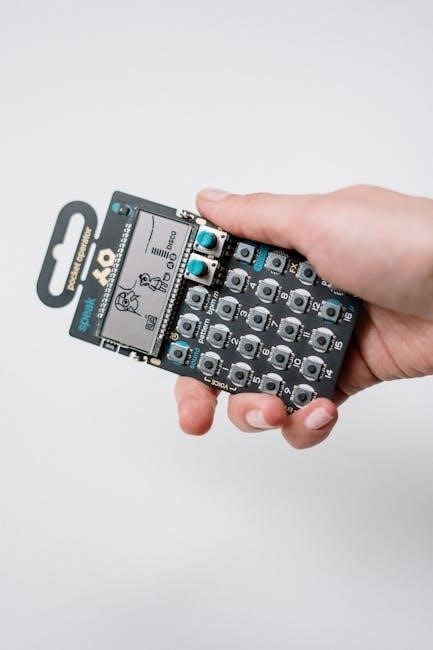
The P-touch features a keypad for input, a display screen for previewing, and a print head/cutter mechanism. Familiarize yourself with these parts for efficient labeling, per the manual.
Keypad and Buttons Explained
P-touch keypads vary by model, but common buttons include power, clear, backspace, print, and shift. The alphanumeric keys enable text entry, while function keys access symbols and formatting options.
Refer to your specific manual for detailed explanations of each button’s function. Understanding these controls is crucial for creating customized labels efficiently. The guide will illustrate how to navigate the menu and utilize all available features for optimal labeling results.
Display Screen Overview
The P-touch display screen provides a preview of your label, showing text, formatting, and selected symbols. It also indicates battery life and error messages.
Different models feature varying screen types – some LCD, others more advanced. Consult your manual to understand the icons and information displayed. The screen is vital for confirming your label design before printing, ensuring accuracy and a professional finish, as detailed in the product guide.
Print Head and Cutter Mechanism
The P-touch print head utilizes thermal technology to transfer ink onto the label tape. Manuals emphasize avoiding contact with the print head to prevent damage. The automatic cutter cleanly separates labels after printing, guided by the colon (:) marks.
Do not attempt to print with an empty tape cassette, as this can harm the print head. Proper maintenance, including cleaning, ensures optimal performance and longevity, as outlined in the product guide.

Creating Your First Label
Begin by powering on your P-touch. Enter text using the keypad, selecting desired font size and style. Follow the manual for initial setup and printing.
Powering On the Device
Powering on your Brother P-touch is straightforward. Typically, a dedicated power button initiates the device. Ensure batteries are correctly installed, or the AC adapter is connected, as detailed in the manual. The display screen will illuminate, indicating the device is ready.
If the device doesn’t power on, verify battery polarity or adapter connection. Refer to the troubleshooting section of your P-touch guide for further assistance; A functioning power supply is crucial for creating your first label.
Entering Text and Numbers
Utilize the P-touch labeler’s keypad to input your desired text and numbers. Most models feature an alphanumeric keyboard. Press the appropriate keys to type, and use the shift key for uppercase letters or symbols. The display screen will show your input in real-time.
Consult your manual for specific key functions. Correct errors using the delete or backspace key. Ensure accurate input before proceeding, as this forms the core of your label content.
Selecting Font Size and Style
The P-touch labeler allows customization of font size and style for visual clarity. Navigate the menu using the keypad to access font options. Typically, you can choose from various sizes – small, medium, large – and styles like bold, italic, or outline.
Refer to your device’s manual for a complete list of available fonts. Preview your selection on the display screen before printing to ensure readability and desired aesthetic. Experiment to find the perfect look!
Advanced Labeling Features
P-touch labelers offer features beyond basic text, including symbols, frames, date/time stamping, and even barcode creation for enhanced organization and identification.
Using Symbols and Frames
P-touch labelers enhance label aesthetics with built-in symbols and frames. Accessing these features through the device’s keypad allows for visual cues and professional presentation. Symbols can highlight important information, while frames neatly enclose text, improving readability.
Experiment with different combinations to create visually appealing and informative labels. Refer to your P-touch manual for a complete list of available symbols and frame options. These additions transform simple labels into impactful organizational tools, streamlining identification and categorization.
Adding Date and Time
P-touch labelers streamline organization by automatically incorporating date and time onto labels. This feature is invaluable for inventory management, labeling files, or tracking expiration dates. Access the date/time function via the device’s menu, customizing the format to your preference.
The manual provides detailed instructions on setting the correct date and time. Utilizing this function ensures labels remain current and informative, enhancing efficiency and reducing errors. Consistent date and time stamping offers a clear record of when items were labeled.
Creating Barcodes
Certain P-touch models offer barcode printing capabilities, enhancing asset tracking and inventory control. Access the barcode function through the labeler’s menu, selecting the desired barcode type – often Code 39 or Code 128. Input the necessary data, adhering to barcode symbology requirements.
Consult your P-touch’s manual for specific instructions and supported barcode formats; Properly generated barcodes streamline scanning processes, improving accuracy and efficiency. Ensure clear printing for reliable barcode readability, optimizing workflow and data management.

Tape Cassette Types and Compatibility
P-touch labelers utilize various tape widths and materials. Ensure compatibility with your specific model, referencing the manual for approved cassettes.
Selecting the correct tape guarantees optimal print quality and longevity.
Different Tape Widths Available
Brother P-touch labelers accommodate a range of tape widths, typically from 3.5mm to 24mm (approximately 0.14 to 0.94 inches). Common sizes include 6mm, 9mm, 12mm, 18mm, and 24mm.
The optimal width depends on the labeling application; narrower tapes suit small items, while wider tapes are ideal for larger surfaces or more prominent identification. Always consult your labeler’s manual to confirm compatible tape widths for your specific model, ensuring proper functionality and print quality. Using unsupported widths may cause errors.
Choosing the Right Tape Material
Brother P-touch labelers support diverse tape materials, including laminated, non-laminated, and specialty options. Laminated tapes offer durability against abrasion, chemicals, and UV exposure, ideal for outdoor or harsh environments. Non-laminated tapes are cost-effective for indoor, temporary labeling.
Specialty tapes include flexible ID tapes, tamper-evident tapes, and extra-strong adhesive options. Refer to your labeler’s manual for compatibility and select a material suited to the application’s demands, ensuring longevity and readability.
Compatibility with Specific P-Touch Models
Brother P-touch models exhibit varying tape cassette compatibility. Always consult your device’s manual or the Brother support website to confirm supported tape widths and types. Some models exclusively accept standard cassettes, while others accommodate laminated or specialty options.
Using incompatible tapes can damage the print head or result in poor print quality. PDF user manuals detail specific model compatibility, ensuring optimal performance and preventing potential issues. Verify before purchasing to avoid frustration.
Troubleshooting Common Issues
Common problems include printing failures and tape jams. Refer to the manual; avoid printing with empty cassettes to prevent print head damage.
Error messages indicate specific issues – consult the guide for solutions.
Labeler Not Printing
If your P-touch labeler isn’t printing, first ensure a properly installed tape cassette. Verify batteries aren’t depleted or incorrectly inserted, as this is a frequent cause.
Check the print density setting; a low setting might make labels appear blank. Also, confirm the print head isn’t damaged by attempting to print a test label.
Consult the manual for specific error codes displayed, as these pinpoint the problem. Avoid using an empty cassette, which can harm the print head, according to safety instructions.
Tape Jamming
Tape jamming in your P-touch labeler requires careful attention. Do not forcefully pull the tape, as this can damage the mechanism. Power off the device immediately and open the tape compartment.
Gently remove any tangled tape, ensuring no small pieces remain inside. Reinstall the cassette correctly, following the manual’s instructions.
Avoid using low-quality or expired tape, as it’s more prone to jamming. Regularly cleaning the print head can also prevent future occurrences, maintaining optimal performance.
Error Messages and Their Meanings
Your P-touch labeler displays error messages to indicate issues. A common message relates to an empty tape cassette – replace it immediately. Other errors might signal a print head problem, requiring cleaning or potential service.
Consult your P-touch’s manual for a complete list of error codes and their specific meanings. Ignoring these messages can lead to further damage.
Referencing the guide ensures correct troubleshooting, preventing unnecessary repairs and maintaining optimal labeling functionality.

Maintaining Your P-Touch Labeler
Regular cleaning of the print head and timely battery replacements are crucial for optimal performance. Proper storage, as outlined in the manual, extends the P-touch’s lifespan.
Cleaning the Print Head
Maintaining a clean print head is vital for consistent, high-quality labels. Dust and debris can accumulate, causing faded or incomplete prints. Gently clean the print head using a soft, dry cloth or cotton swab.
Avoid using abrasive cleaners or liquids, as these can damage the delicate components. The P-touch manual provides specific cleaning instructions for your model. Regular cleaning, even with infrequent use, prevents build-up and ensures reliable operation. Do not attempt printing with an empty cassette.
Replacing Batteries
When the display indicates low battery power, promptly replace the batteries to avoid interrupted labeling. Use only the battery type specified in your P-touch manual – typically AAA or AA alkaline batteries. Ensure correct polarity when inserting new batteries, following the diagram inside the battery compartment.
Remove depleted batteries immediately to prevent potential leakage and damage. Refer to the product safety guide for safe battery handling. Consistent power ensures optimal performance and prevents errors during label creation.
Storing the Labeler Properly
To prolong the life of your P-touch labeler, store it in a cool, dry place, away from direct sunlight and extreme temperatures. Remove the batteries when storing for extended periods to prevent corrosion and potential damage. Protect the print head from dust and debris by keeping the cover closed.
Avoid storing the labeler with the tape cassette installed, as this can cause the print head to wear out. Consult your manual for specific storage recommendations related to your model.
Understanding Labeler Settings
P-touch labelers offer adjustable settings like print density and auto power-off. Customize display contrast for optimal viewing, enhancing label creation as described in the manual.
Adjusting Print Density
Adjusting print density is crucial for achieving optimal label clarity. Lower density settings are ideal for lighter-colored tapes, preventing a faded appearance. Conversely, higher densities enhance darkness on darker tapes.
Experiment with different levels to find the perfect balance for your specific tape type and desired aesthetic. Refer to your P-touch model’s manual for precise instructions on accessing and modifying these settings. Proper density ensures professional-looking, easily readable labels every time.
Setting Auto Power Off
Auto power off is a valuable feature for conserving battery life on your P-touch labeler. This function automatically shuts down the device after a period of inactivity, preventing unnecessary drain.
Consult your specific model’s manual to locate the auto power off setting within the device’s menu. You can typically adjust the inactivity time before shutdown. Enabling this feature is a simple step towards extending battery life and promoting responsible energy use.
Changing the Display Contrast
Adjusting the display contrast ensures optimal visibility of the P-touch labeler’s screen, especially in varying lighting conditions. Access the contrast settings through the device’s menu, as detailed in your user manual.
Typically, you’ll find options to increase or decrease the contrast level. Experiment with these settings until the text and icons are clear and easy to read. Proper contrast enhances usability and reduces eye strain during label creation.
Using the Built-in Memory
P-touch labelers feature built-in memory for saving frequently used label templates and text. This allows quick recall, streamlining repetitive labeling tasks for efficiency.
Saving Label Templates
P-touch labelers allow you to store customized label designs for future use, eliminating the need to repeatedly enter the same information. After creating your desired label – including text, symbols, and formatting – utilize the device’s memory function.
Typically, this involves accessing a “Save” or “Memory” option within the labeler’s menu. You may be prompted to assign a number or name to the template for easy identification. Saved templates can be incredibly useful for frequently used labels, like address labels or file folder designations.
Recalling Saved Labels
To reuse a previously saved label template on your P-touch, access the memory function through the device’s menu. Navigate to the “Recall” or “Load” option, where you’ll see a list of your stored templates, often identified by their assigned numbers or names.
Select the desired template, and the labeler will automatically load the saved design. You can then print the label as is, or make minor edits before printing. This feature streamlines repetitive labeling tasks, saving time and ensuring consistency.
Cutting and Applying Labels
Utilize the automatic cutter for clean separation, or manually cut with scissors. Ensure proper adhesion by cleaning the surface before applying your P-touch labels.
The guide mark aids precise cutting, while firm pressure guarantees a secure, lasting bond.
Using the Automatic Cutter
Brother P-touch labelers feature a convenient automatic cutter for quick and efficient label separation. After printing, press the dedicated cut button – often indicated by scissors icon – to cleanly sever the label.
The manual emphasizes avoiding forceful pulls, as this can damage the mechanism. Some models offer a half-cut function, leaving a portion of the backing for easier peeling. Always refer to your specific model’s guide for precise instructions. Ensure the cutter blade remains clean for optimal performance, preventing jams and ragged edges.
Manually Cutting Labels
If your P-touch model lacks an automatic cutter, or if it malfunctions, manual cutting is necessary. Utilize sharp scissors or a craft knife for clean separation, carefully following the guide marks printed between labels.
The manual advises against using dull blades, which can tear the label. Exercise caution to avoid cutting into the printed text. For longer labels, a ruler can aid precision. Remember safety first when using sharp tools, and always cut away from your body, as detailed in the product safety instructions.
Proper Label Application Techniques
Ensure surfaces are clean, dry, and free of dust or grease before applying labels for optimal adhesion. Gently peel the label from its backing, avoiding any stretching or tearing. Press firmly, starting from one edge and smoothing outwards to eliminate air bubbles.
The manual suggests using a credit card or similar tool for smoothing. For curved surfaces, consider using a narrower tape width. Avoid applying labels in extremely cold or humid conditions, as this can affect adhesion, as per the instructions.
Safety Precautions
Avoid print head damage by not using empty cassettes. Handle batteries carefully and prevent electrical shock; always refer to the manual for instructions.
Avoiding Damage to the Print Head
Protecting the print head is crucial for your P-touch labeler’s longevity. Do not attempt to print labels with an empty tape cassette, as this can cause significant and potentially irreparable damage.
Regular cleaning, as outlined in the manual, helps prevent debris buildup. Always ensure proper tape insertion and avoid forcing the cassette. Following these instructions will maintain optimal print quality and extend the life of your device.
Handling Batteries Safely
Always remove batteries if the P-touch labeler will not be used for an extended period to prevent corrosion and potential leakage. When replacing batteries, ensure correct polarity, as indicated in the manual.
Dispose of used batteries responsibly, following local regulations. Do not mix old and new batteries, or different battery types. Safe battery handling ensures both user safety and the longevity of your labeling device.
Preventing Electrical Shock
Never attempt to disassemble or modify the P-touch labeler, as this could expose you to dangerous electrical components. Do not use the device with damaged cords or plugs. Keep the labeler away from water and moisture to minimize shock risk.
Always unplug the device before cleaning. If the labeler malfunctions, consult the manual or a qualified technician. Prioritizing these precautions ensures safe operation and prevents potential electrical hazards.

Finding Additional Resources
Explore the Brother P-Touch support website for manuals, FAQs, and troubleshooting. PDF user manuals are available, requiring Adobe Acrobat Reader for access and guidance.
Brother P-Touch Support Website
Brother’s official support website is a comprehensive hub for all P-touch labeler needs. It provides access to downloadable manuals, troubleshooting guides, and frequently asked questions (FAQs) designed to resolve common issues.
Users can find detailed instructions, software updates, and helpful tips to maximize their labeler’s functionality. The website also offers a searchable database, allowing quick access to specific information regarding various P-touch models and tape options.
Directly accessing this resource ensures users have the latest support materials at their fingertips.
Online User Manuals and Guides
Numerous online resources offer P-touch labeler manuals and guides, supplementing the official Brother support site. These digital documents provide step-by-step instructions for setup, operation, and troubleshooting.
PDF versions are readily available, often requiring Adobe Acrobat Reader for viewing. These guides detail everything from inserting tape cassettes to utilizing advanced features like barcode creation. Accessing these resources ensures users can quickly learn and master their labeler’s capabilities, enhancing productivity and label quality.
Frequently Asked Questions (FAQ)
Common questions regarding P-touch labelers often center around tape jamming and printing issues. Users frequently inquire about error messages and their meanings, seeking solutions for a non-printing device.
Another frequent concern involves proper tape cassette insertion and avoiding damage to the print head by attempting to print with an empty cassette. Online resources and manuals address these issues, offering troubleshooting steps and preventative measures for optimal performance.